Manage Change Risk
.
Change Risk
In the Change Risk settings, configure risk evaluation criteria for your organization, adjust the weightings of each risk category, configure the Change Risk Dashboard settings, and determine if risk assessments will be passed to your ITSM system.
Change Risk Settings
In the Change Risk Settings section, you can configure:
Change Risk Profiles
Use change risk profiles to create multiple, separate change risk configurations. Change risk profiles can be used to filter the Change Risk Dashboard. This is helpful for organizations that have teams that use different risk evaluation criteria.

In Change Risk Settings, select a change risk profile to view or edit from the drop-down menu.
Best practice
When editing any of the change risk settings, always verify that you have the correct profile selected before saving any changes.
The default change risk profile has a star next to the name. The default change risk profile always opens first when you go to the change risk configuration page.
Create a New Change Risk Profile
To create a new change risk profile:
Click Create New.
In the Create New Profile window, populate the following information:
Profile Name - a descriptive name for the change risk profile.
Description (Optional) - information about the profile's use or goals.
Copy from current single-mode settings - click the box to copy the current settings as a template for creating the new profile.
Click Create Profile.
(Optional) If you would like this profile to be the default that appears when you enter the configuration page, click Set as Default.
Manage Change Risk Profiles
To edit a change risk profile, click the Pencil icon, update the Profile Name or Description and click Update Profile.
To change the default change risk profile, go to the profile you'd like to set as default and click the Set as Default button.
To delete a change risk profile, click the Trash Can icon and select Confirm.
Org-Specific Risk Evaluation
In addition to the risk analysis AI Incident Prevention performs, you can also define your own evaluation criteria.
Under Evaluation Instructions, define additional evaluation guidelines for the LLM to follow.
Writing custom risk evaluation instructions
Write evaluation instructions the same way you would explain to a coworker what makes a change risky or not.
You can write these instructions in a free-form way or use if/else decision logic format.
Change Eligibility / Retrieval
In the Change Eligibility / Retrieval section, view which changes from ServiceNow are eligible for risk assessment for the selected change risk profile.
Read-only settings
Change Eligibility / Retrieval settings can only be updated by BigPanda. If you need to edit these settings, contact your BigPanda account team.
Change Eligibility/ Retrieval Control
Change Eligibility / Retrieval settings control which changes are retrieved from ServiceNow via a polling mechanism and then evaluated by the Change Risk Prediction engine. This retrieval is separate from Unified Data Connector filters.
The ServiceNow Query Filter field uses a query string to filter which changes from ServiceNow are indexed.
The Scheduled Start Field determines when changes are scheduled.
The Last Indexed Value displays the last sys_updated_on value that was successfully processed by the indexing service.
Risk Category Weightings
Under Risk Category Weightings, adjust the weight of risk categories. These weightings determine how the final risk score is calculated.
Adjust the weightings using the sliding bar or by typing a number into the box on the right side of each category.
Total weightings
The total of all risk category weightings must equal 100.
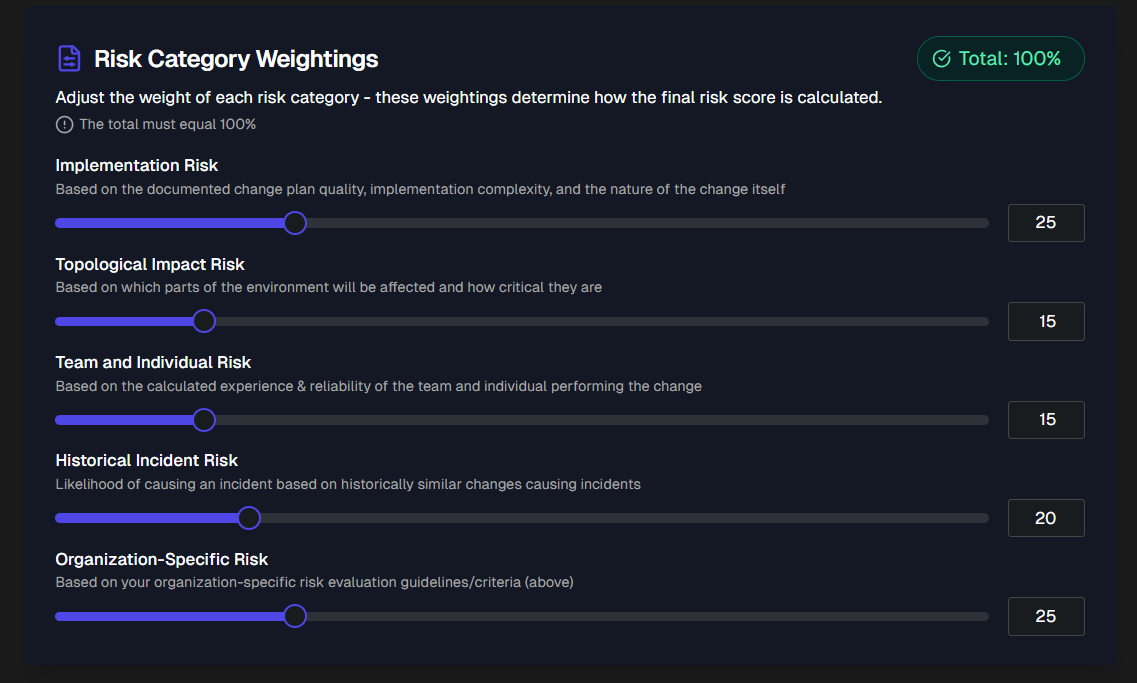
The following risk categories are available:
Risk Category | Description |
|---|---|
Implementation Risk | Documented change plan quality, implementation complexity, and the nature of the change. |
Topological Impact Risk | Which parts of the environment will be affected and how critical they are. |
Team and Individual Risk | The calculated experience level and reliability of the team or individual performing the change. |
Historical Incident Risk | Likelihood of causing an incident based on historically similar changes that caused incidents. |
Organization-Specific Risk | Your organization-specific risk evaluation guidelines or criteria, defined in Evaluation Instructions. |
Field Visibility Settings
In the Field Visibility Settings, determine which fields will appear by default in the Change Risk Dashboard Change Details tab.
User default settings
Individual users can select their own default fields in the Change Details tab. User defaults are user-specific and take precedence over field visibility settings.
Use the toggles to enable or disable Standard Fields, or search for Additional ServiceNow Fields to display.

Dashboard Settings
Under Dashboard Settings, configure how the Change Risk Dashboard appears for users in your organization.
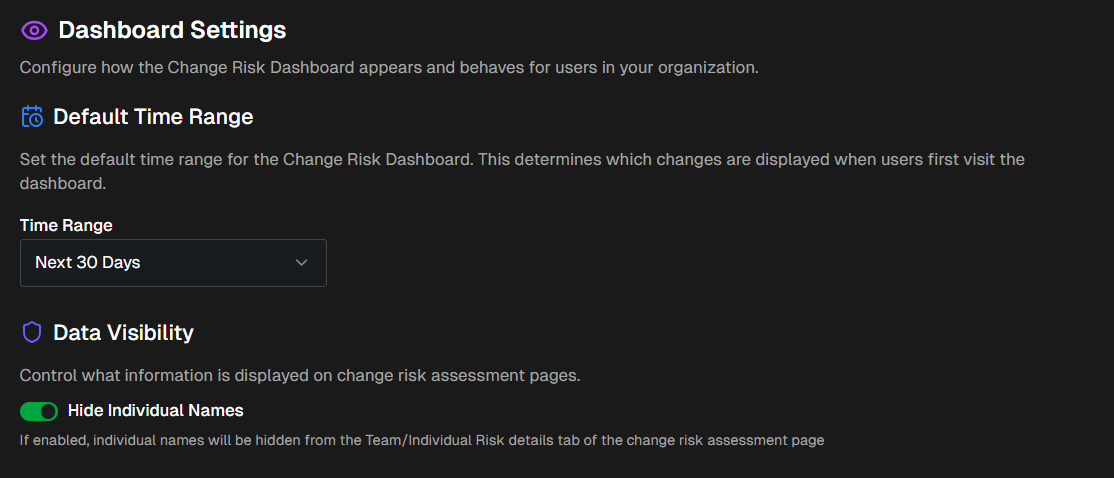
In the Default Time Range section, set the default time range for the Change Risk Dashboard. This determines which changes are displayed when users first visit the dashboard.
In the Data Visibility section, determine what information is displayed on change risk assessment pages. Use the Hide Individual Names toggle to determine whether or not names will appear in the Team or Individual Risk details tab.
Notification Settings
Under Notification Settings, configure notifications for high-risk changes.
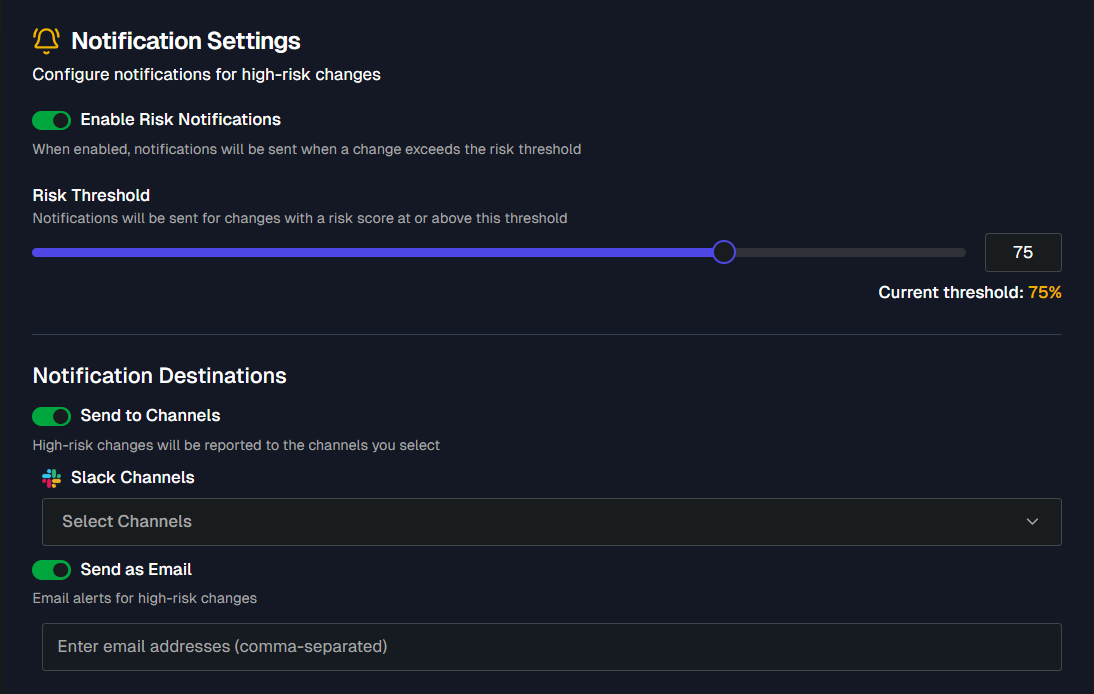
Use the Enable Risk Notifications toggle to determine if notifications will be sent when a change exceeds the risk threshold.
When risk notifications are enabled, you can set the Risk Threshold for when notifications will be sent. Changes with a risk score at or above the threshold will trigger a notification.
Notification Destinations
The Notification Destinations section appears if you've enabled risk notifications.
Toggle Send to Channels on to send high-risk changes to Slack or Teams channels. Use the drop-down menu to select one or more channels to send changes to.
Toggle Send as Email on to send changes to specific email addresses. Enter a comma-separated list of email addresses to receive notifications in the text box.
Category Score Notification Thresholds
You can choose to receive notifications when a risk category score exceeds a specific threshold.
To enable notifications for a specific risk category, click the toggle next to the category name and select the Score Threshold.

Whenever a category receives a risk score above the threshold, a notification will be sent to the configured notification destination(s).
Post Results to ITSM Record
If ServiceNow is your change tool, you can define where and how analysis outputs are written into change records.
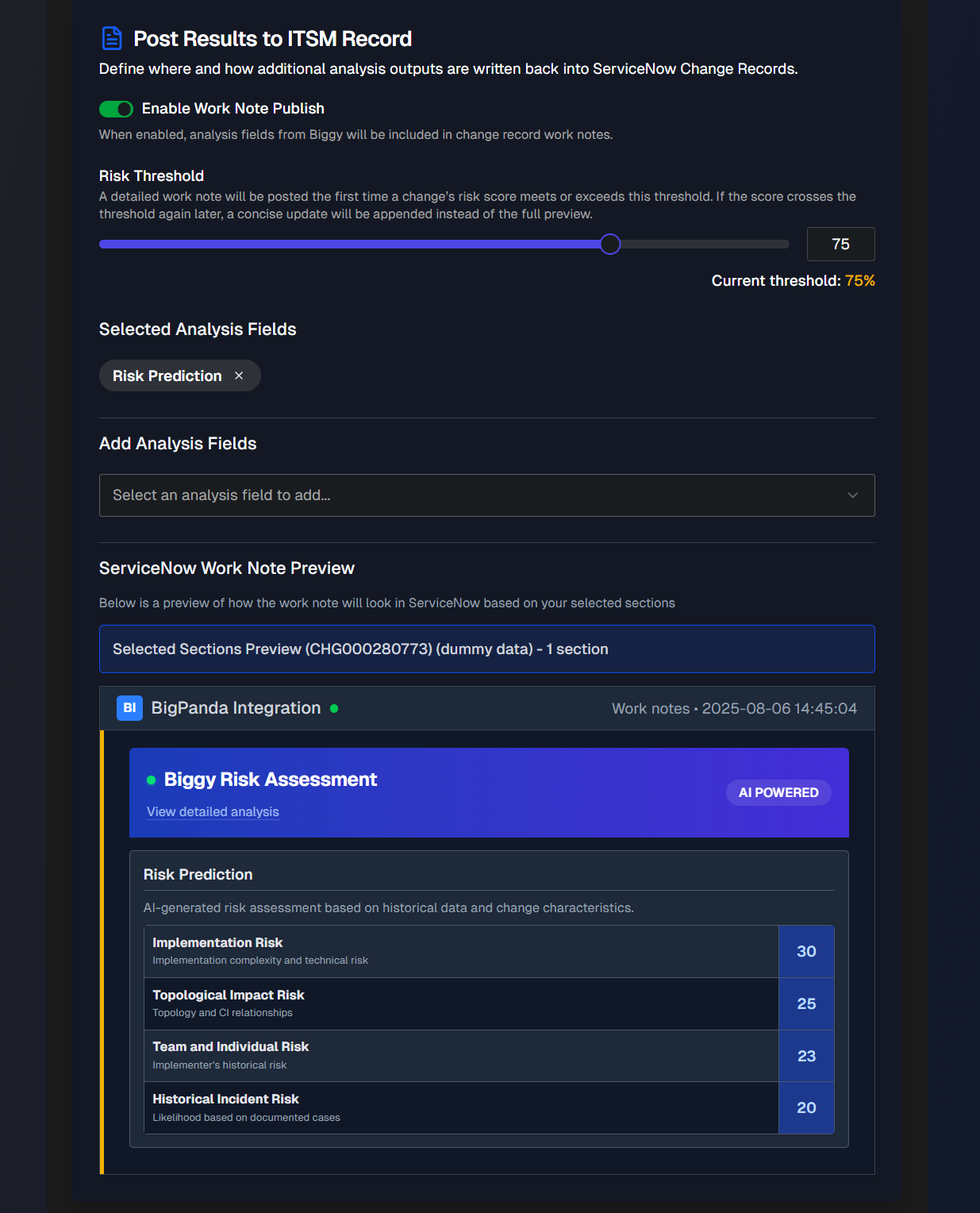
Toggle Enable Work Note Publish on to include analysis fields from AI Incident Assistant in ServiceNow change record work notes.
In the Risk Threshold section, define the risk score that a change must meet or exceed to be posted to a work note. If the score crosses the threshold again later, a concise update will be appended instead of the full preview.
Click the Add Analysis Fields drop-down to select the fields to be included. The following options are available:
Field | Description |
|---|---|
Overall Risk | Overall risk score and rating for the change. |
Risk Prediction | Analysis of potential risks and outcomes. |
Risk Reasoning | AI-generated reasoning explaining the risk assessment rationale. |
Suggested Mitigations | Recommended actions to reduce identified risks. |
After selecting analysis fields, the ServiceNow Work Note Preview appears.